Travel Tech President and CEO Laura Chadwick testified before the Pennsylvania House Committee on Tourism, Recreation and Economic Development on House Bill 2303, legislation addressing compliance requirements for short-term rentals.
In her testimony, Chadwick highlighted the importance of maintaining consumer choice in lodging and preserving the economic benefits that short-term rental platforms provide to Pennsylvania communities.
“Travel Tech members create marketplaces where travel providers compete directly, helping keep travel more affordable and accessible for everyday Americans,” Chadwick said.
Short-term rentals play a significant role in Pennsylvania’s economy. In 2024, activity on Travel Tech member platforms generated $1.8 billion in GDP impact, supported more than 22,000 jobs, and produced $501 million in host earnings.
Travel Tech expressed support for several elements of HB 2303, including distinctions between different types of short-term rentals, preservation of local zoning authority, and efforts to improve tax compliance.
However, Chadwick cautioned that the bill, as drafted, creates a comprehensive statewide regulatory framework that goes beyond recommendations from Pennsylvania’s Joint State Government Commission and could impose disproportionate burdens on small hosts.
Travel Tech urged lawmakers to ensure that any regulatory approach is appropriately tailored, avoids unnecessary compliance costs, and does not reduce supply or limit consumer choice—particularly in communities that rely on tourism.
Travel Tech looks forward to continued engagement with policymakers to support a framework that promotes transparency, competition, and a vibrant travel marketplace.
###
The Travel Technology Association (Travel Tech) empowers traveler choice by advocating for public policy that promotes transparency, competition and innovation. Travel Tech represents travel technology innovators ranging from dynamic startups, small, and midsize businesses to leading online travel agencies, metasearch engines, short-term rental platforms, global distribution systems, and travel management companies.
To schedule an interview with a Travel Tech spokesperson, contact rtownsend@belverapartners.com.
Wednesday, April 1st, 2026 — The Travel Technology Association (Travel Tech) hosted its March Start-Up Member Meet-Up on March 31st, featuring Venkat Chandramoleshwar for a candid discussion on “Avoiding Launch Pitfalls: Real-World Go-To-Market (GTM) and Scaling Insights in Travel Tech.”
Drawing on his experience at Google, ITA Software, and United Airlines, Venkat shared practical lessons on how early-stage travel tech companies can move from pilot to scale. His presentation focused on three key areas: identifying the right launch partners, avoiding common go-to-market pitfalls, and building strategies that enable sustainable growth.
Through real-world examples — including ITA Software’s early partnership with Orbitz and the evolution of Google’s travel products — Venkat emphasized the importance of working with partners who are both visionary and capable of execution, as well as the critical role of timing and continuous iteration.
Following the presentation, members participated in a “Runways & Roadblocks” community discussion, where several shared recent announcements from their companies— including new integrations, product launches, and early partnership traction.
The meet-up also included a policy update from Laura Chadwick, highlighting current challenges impacting the travel industry, such as declining international inbound travel to the U.S. and increasing state-level activity related to AI and dynamic pricing.
Interested in attending Travel Tech’s next Start-Up Meet-Up on Tuesday, April 28th?
The Travel Technology Association (Travel Tech) empowers traveler choice by advocating for public policy that promotes transparency, competition and innovation. Travel Tech represents travel technology innovators ranging from dynamic startups, small, and midsize businesses to leading online travel agencies, metasearch engines, short-term rental platforms, global distribution systems, and travel management companies.
Industry group highlights potential administrative burdens and state costs from House Bill 994, urging targeted, consumer-focused solutions
Thursday, March 26, 2026 — The Travel Technology Association (Travel Tech), a non-profit dedicated to promoting and protecting the travel technology industry, is warning industry members about Maryland House Bill 994, which would impose new financial security requirements on certain sellers of travel. H.B. 994 was approved by the Maryland House of Delegates earlier this week and is now under consideration by the Maryland Senate Finance Committee.
The legislation would require travel sellers to:
Maintain financial security instruments, such as surety bonds or other forms of coverage, regardless of existing financial oversight or business model;
Register with the state and pay ongoing fees, creating new administrative and compliance obligations; and
Submit to state oversight and reporting requirements, which may duplicate existing regulatory frameworks and impose additional operational complexity.
Similar regulatory regimes exist in states such as California and Florida, where “seller of travel” laws impose registration and financial responsibility requirements. However, those frameworks are often more tailored and include clearer consumer restitution mechanisms.
Travel Tech previously submitted comments to lawmakers noting that the bill could create unnecessary and duplicative regulatory requirements for established travel technology companies, including online travel agencies, metasearch platforms, and travel management companies—many of which already operate under significant financial oversight.
“Travel Tech supports strong consumer protections, but policies should be carefully tailored to address real risks,” said Laura Chadwick, President & CEO of Travel Tech. “As drafted, this legislation risks imposing new administrative burdens without clear consumer benefit.”
The bill now moves to the Maryland Senate Finance Committee for further consideration. Travel Tech will continue engaging with policymakers to encourage a more targeted approach that protects consumers while avoiding unnecessary costs and complexity for businesses and the state.
###
The Travel Technology Association (Travel Tech) empowers traveler choice by advocating for public policy that promotes transparency, competition and innovation. Travel Tech represents travel technology innovators ranging from dynamic startups, small, and midsize businesses to leading online travel agencies, metasearch engines, short-term rental platforms, global distribution systems, and travel management companies.
Tuesday, March 24, 2026 — The Travel Technology Association (Travel Tech), a non-profit dedicated to promoting and protecting the travel technology industry, today applauded the passage of H.R. 5663, the ACPAC Modernization Act, a key legislative priority that will strengthen consumer protection policymaking at the U.S. Department of Transportation (DOT).
The legislation makes a targeted update to DOT’s Aviation Consumer Protection Advisory Committee (ACPAC) by adding a “ticket agent” representative as a statutory member—ensuring the committee reflects the full range of stakeholders involved in the air travel marketplace.
Travel Tech’s members, including online travel agencies, global distribution systems, and travel management companies, which are considered to be “ticket agents” by the DOT, facilitate nearly 40 percent of all U.S. airline ticket sales and play a central role in delivering fare transparency, booking tools, refund support, and real-time assistance to travelers. Their inclusion on ACPAC will help ensure more informed, balanced, and effective policy recommendations.
“Ensuring the travel technology industry has a seat at the policymaking table is core to Travel Tech’s mission,” said Laura Chadwick, President & CEO of Travel Tech. “With the passage of H.R. 5663, the ACPAC Modernization Act today, the U.S. House of Representatives has taken an important step to equip the Department of Transportation with the expertise needed to address today’s airline consumer protection challenges. We are grateful for Congresswoman Titus’s leadership on this legislation and for her recognition of the essential role ticket agents play in supporting millions of consumers.”
Travel Tech thanked Representatives Dina Titus (D-NV), Dave Taylor (R-OH), and Shomari Figures (D-AL) for their leadership in advancing the legislation and commended Congress for recognizing the essential role ticket agents play in supporting millions of travelers.
***
The Travel Technology Association (Travel Tech) empowers traveler choice by advocating for public policy that promotes transparency, competition and innovation. Travel Tech represents travel technology innovators ranging from dynamic startups, small, and midsize businesses to leading online travel agencies, metasearch engines, short-term rental platforms, global distribution systems, and travel management companies.
Washington, D.C. — The Travel Technology Association (Travel Tech) expressed support for the bipartisan, bicameral USMCA Travel and Tourism Resiliency Act (S.3787 / H.R.7454), which would direct the U.S. Trade Representative to prioritize the creation of a Travel and Tourism Trade Working Group during the upcoming review of the United States–Mexico–Canada Agreement (USMCA).
The first six-year USMCA joint review is scheduled for July 1, 2026, and travel and tourism are not currently represented among the agreement’s existing working groups.
Travel Tech commended Senators Catherine Cortez Masto (D-NV) and Jerry Moran (R-KS) and Representatives Dina Titus (D-NV), Vern Buchanan (R-FL), and Gus Bilirakis (R-FL) for introducing the legislation.
“Travel and tourism are foundational to the U.S. services economy and deeply integrated across North America,” said Laura Chadwick, President & CEO of Travel Tech. “Establishing a dedicated working group within USMCA will help ensure the sector remains competitive and responsive to modern cross-border realities.”
International travel is a key U.S. export, with $251.6 billion in visitor spending in 2024, accounting for 22% of U.S. services exports and supporting 1.8 million jobs, according to the International Trade Administration. At the same time, 107.7 million Americans traveled abroad in 2024, underscoring the importance of efficient two-way travel flows across North America.
Travel Tech encouraged policymakers to address both inbound and outbound travel and reduce cross-border friction to strengthen the region’s travel economy.
Travel Tech has issued an “Action Alert” encouraging its members and industry stakeholders to contact their Representatives to support a USMCA Travel and Tourism Trade Working Group (S.3787 / H.R.7454), through its Policy Action Center.
The Travel Technology Association (Travel Tech) empowers traveler choice by advocating for public policy that promotes transparency, competition and innovation. Travel Tech represents travel technology innovators ranging from dynamic startups, small, and midsize businesses to leading online travel agencies, metasearch engines, short-term rental platforms, global distribution systems, and travel management companies.
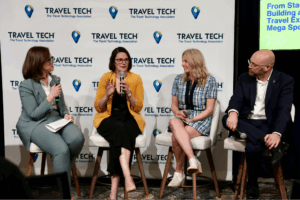
March 6, 2026 —The Travel Technology Association (Travel Tech) recently sponsored Travel Massive SF’s community event, bringing together travel startup founders, operators, creators, and investors for Innovation Night: Building the Future of Travel. The event took place on Thursday, March 5, 2026, at the Hotel Emblem in San Francisco, and featured a live panel moderated by Travel Tech President & CEO Laura Chadwick.
The all-female panel included:
Hayley Melidonis, CEO & Founder of Bubbl
Anjali Kakkad, Lead TPM, Google Maps & Founder, Aligned Rewards
Kavitha Ramaswamy, Chief of Staff at Mercurius Media Capital
The discussion focused on the barriers to innovation that the travel tech innovators and broader travel industry face, especially during this new AI era. The group discussed launching early products, landing the first 100 customers, testing new tools, and navigating growth in a complex global market. Panelists shared candid insights on what makes travel tech startups succeed, from integrating systems efficiently to prioritizing solutions that address real industry challenges.
The Travel Technology Association (Travel Tech) empowers traveler choice by advocating for public policy that promotes transparency, competition and innovation. Travel Tech represents travel technology innovators ranging from dynamic startups, small, and midsize businesses to leading online travel agencies, metasearch engines, short-term rental platforms, global distribution systems, and travel management companies.
Industry group warns proposals could restrict discounts, increase prices, and create a patchwork of state pricing rules
March 4, 2026 — The Travel Technology Association (Travel Tech) sent letters this week to lawmakers in Connecticut, Maryland, Ohio, and Tennessee ahead of upcoming public hearings on state “price surveillance” bills that would impose new restrictions on algorithmic pricing used in online markets, including the travel industry.
The proposals are part of a growing wave of legislation introduced across the country this year seeking to regulate the use of algorithms and artificial intelligence in pricing.
“Price surveillance bills continue to mount across the country, and many would fundamentally restrict how travel companies use dynamic pricing to manage perishable inventory like hotel rooms, rental cars, and experiences,” said Laura Chadwick, President and CEO of the Travel Technology Association. “If enacted, these proposals would increase operational costs, create conflicting compliance obligations across states, and make it harder for travel companies to align prices with real-time market conditions.”
Travel Tech warned that several of the proposals could unintentionally restrict common consumer benefits, including discounts, loyalty programs, and promotional pricing.
“Instead of helping the market work better, many of these bills risk locking inefficiencies into the system and pushing companies toward blunt, one-size-fits-all pricing,” Chadwick said.
The bill would require companies to disclose when an algorithm uses personal data to determine pricing, mandating a statement reading: “THIS PRICE WAS SET BY AN ALGORITHM USING YOUR PERSONAL DATA.”
Travel Tech warned the measure could capture common discount programs that are not materially personalized and create legal uncertainty for companies operating nationwide.
The proposal would prohibit merchants from using “personalized algorithmic pricing” unless a specified disclosure accompanies the price shown to consumers.
Travel Tech cautioned that the bill could disrupt established pricing practices and introduce compliance challenges across interstate digital markets.
The legislation would ban the use or distribution of pricing algorithms trained on nonpublic competitor data and require businesses to disclose whether algorithms influence pricing decisions.
Travel Tech said the proposal could create “a presumption of conspiracy based on shared technology” and impose liability on neutral software providers.
One proposal would prohibit certain forms of personalized algorithmic pricing, while another would establish a state-specific labeling regime for lodging price disclosures.
Travel Tech warned the measures could increase costs for consumers and create new inconsistencies in interstate travel pricing rules.
Policymaker Engagement
Travel Tech said it is working with lawmakers across the country to ensure consumer protection proposals are carefully tailored and do not unintentionally restrict competition or eliminate consumer discounts.
The association proposed amendments to narrow overly broad definitions, clarify how the bills apply to travel intermediaries, and ensure enforcement provisions remain proportionate.
“Transparency and consumer protection are important goals,” Chadwick said. “But policies should reflect how modern digital markets actually work so they don’t reduce discounts, fragment interstate commerce, or make travel more expensive for consumers.”
Washington, D.C. — The Travel Technology Association (Travel Tech) today marked the 30th anniversary of Section 230 of the Communications Decency Act, signed into law in February 1996, a foundational law that helped enable the online consumer review systems now central to travel planning and booking.
For travelers, reviews have become a core decision-making tool — shaping how trips are researched, compared, and ultimately booked. Section 230 allows travel platforms and suppliers to host user-generated reviews while moderating content in good faith, supporting both consumer transparency and efforts to combat fraud and abuse.
“Online reviews are a core part of the infrastructure of travel commerce,” said Laura Chadwick, President & CEO of Travel Tech. “Section 230 helped create the framework that allows platforms and suppliers to host community-driven feedback while investing in moderation and trust tools that travelers depend on.”
Travel Tech members helped pioneer the use of user-generated content in the early 2000s, revolutionizing how travelers plan trips and explore the world. The ability to offer trusted, community-driven insights without legal exposure has allowed the travel industry to grow, innovate, and deliver better experiences to consumers.
Today, industry research shows how powerful that influence has become: Expedia Group’s 2025 Traveler Value Index found that about three-quarters of travelers say they are willing to pay more for lodging with better reviews, rising to roughly 80% among travelers under 40.
As review volume has grown, travel platforms have expanded investments in trust and safety to protect review integrity. Tripadvisor, for example, has reported publishing more than one billion reviews and continues to use a combination of technology and human moderation to identify fraudulent content.
Reviews and Booking Behavior
Across the travel industry, consumer reviews enabled by Section 230 help travelers:
Compare options with greater confidence
Make faster, better-informed booking decisions
Spot potentially misleading or unsafe listings
Rely on peer insights alongside pricing and availability
“The travel industry works best when travelers trust the information they see,” Chadwick said. “Thirty years on, Section 230 remains an important part of the framework supporting transparency, consumer confidence, and healthy digital marketplaces.”
Wednesday, Feb 18, 2026 – Last week, the Travel Technology Association (Travel Tech) hosted its third Quarterly Start Up & Investor Connect Webinar, where four early-stage founders pitched to a panel of angel and seed stage investors. Across the hourlong session, one theme emerged unmistakably: travel tech innovation is shifting decisively toward AI-powered operational infrastructure, not incremental consumer features.
Start-ups Chirrup, HousMthr, Lake.com, and Vibe Adventures pitched their solutions, fielded live investor questions, and received candid feedback on market fit, scalability, and differentiation.
This quarter’s pitches reflected a broader trend across travel tech: founders are moving beyond incremental features to tackle foundational industry pain points—particularly around payments, operational efficiency, and modern infrastructure for suppliers and platforms.
Throughout the session, investors asked questions on scalability, integration capabilities, and defensible go-to-market strategies. Their questions reflected a broader trend in early-stage travel investment: solutions that modernize core infrastructure – rather than incremental consumer features – are attracting the most attention.
“What stood out in this session wasn’t just the high quality of the pitches, but the consistency of the problems founders are trying to solve,” said Laura Chadwick, President and CEO of Travel Tech. “Investors are clearly responding to start-ups that address real operational gaps in travel—whether that’s payments, infrastructure, or smarter use of technology—rather than point solutions in search of a problem. These founders are building for where travel is going, not where it’s been.”
Chirrup introduced its AI-enabled communications platform built specifically for tour and activity operators. The system consolidates calls, texts, and booking data into a single inbox, supported by AI chat and voice bots and smart routing. The company currently serves 23 customers and processes approximately 80,000 messages per month, with integrations completed in as little as one week. Enabled communications platform built specifically for tour and activity operators. The system consolidates calls, texts, and booking data into a single inbox, supported by AI chat and voice bots and smart routing. The company currently serves 23 customers and processes approximately 80,000 messages per month, with integrations completed in as little as one week.
Lake.com presented its dedicated platform for waterfront vacation rentals and outdoor experiences, offering 40,000 properties across North America and Europe and attracting 100,000 monthly active users. With a 10% commission model, the company positions itself as a family-focused, lower fee alternative to major OTAs and is raising a $3 million seed round to scale bookings and supply.
HousMthr presented its mobile platform built for real-time group trip coordination. The app includes structured tools for room assignments, shared expenses, trip scoping, and AI-powered agents that adapt dynamically to group preferences and on-trip behavior. After a year-long pilot within seasonal rental communities, HousMthr achieved 100% user renewal and 32% growth. Users remained actively engaged for up to nine months per year, demonstrating sustained value beyond traditional pre-trip booking tools.
Vibe Adventures introduced its dynamic packaging engine, combining 20,000+ curated multi-day tours across 160+ countries with global flight inventory. With its bootstrapped, profitable legacy travel business, the company has served 12,000+ customers, generated $2.5+ million in revenue, and is raising a seed round to launch and scale its B2C dynamic packaging platform and launch a white-label B2B2C solution in 2027.
That shift was underscored by attendee voting at the close of the session. A vote was cast and Chirrup was recognized for the most innovative solution to a real challenge and the strongest market potential and scalability, highlighting growing investor interest in solutions addressing friction in travel bookings and operations. Lake.com was also recognized for delivering the most compelling founder story and vision.
The Start-Up & Investor Connect Webinar is part of Travel Tech’s broader effort to support early-stage companies by connecting them directly with travel-savvy investors, industry expertise, and peer founders. Since launching the program, Travel Tech has seen over a dozen start-ups participate and a steady rise in investor engagement across sessions.
Founders interested in pitching in future Start-Up & Investor Connect Webinars can learn more by joining Travel Tech’s Start-Up Membership Program, which also includes access to quarterly pitch opportunities, free enrollment in Matt Zito’s four-week travel tech accelerator, policy and regulatory insights, and year-round networking.
Click here to learn more about Travel Tech’s Start-Up Membership program and upcoming opportunities.
###
The Travel Technology Association (Travel Tech) empowers traveler choice by advocating for public policy that promotes transparency, competition and innovation. Travel Tech represents travel technology innovators ranging from dynamic startups, small, and midsize businesses to leading online travel agencies, metasearch engines, short-term rental platforms, global distribution systems, and travel management companies.
Urges Balanced Approach Travel Tech President and CEO Laura Chadwick testified before the Pennsylvania House Committee on Tourism, Recreation and Economic Development on House Bill 2303, legislation addressing compliance requirements for short-term rentals. In her testimony, Chadwick highlighted the importance of maintaining consumer choice in lodging and preserving the economic benefits that short-term rental platforms […]